
Work was initiated in Russia in 1910 by Colonel Jens Povlsen of Denmark, but circumstances necessitated his withdrawal after 18 months. Army operations then recommenced in St Petersburg in 1913 as an extension to the work in Finland. After the February Revolution of 1917 the work flourished, Russia became a distinct command and reinforcements arrived from Sweden.
As a result of the October Revolution, however, they had to be withdrawn at the end of 1918, leaving 40 Russian and Finnish officers to continue the work under extreme hardship until the Army was finally proscribed in 1923. Salvation Army activities were officially recommenced in Eastern Europe in July 1991, overseen by the Norway, Iceland and The Færoes Territory with the arrival of Lieut-Colonels John and Bjorg Bjartveit. It became a distinct command in November 1992.
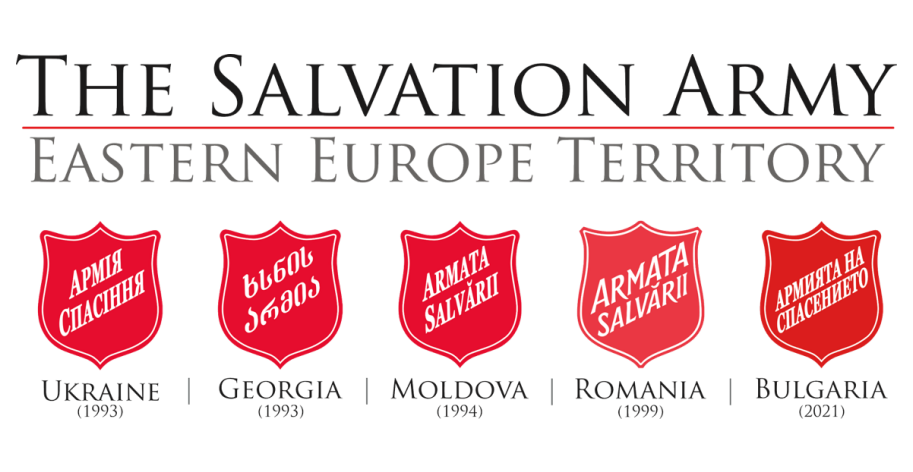
Under the leadership of Commissioner Reinder Schurink, the work was extended to Ukraine (1993), Georgia (1993) and Moldova (1994). The Army began work in Romania in 1999. On 1 June 2001, the command was redesignated the Eastern Europe Command. It was elevated to territory status on 1 March 2005. The final stage of registering ‘the Moscow Branch of The Salvation Army’ was completed in April 2009. The year 2015 brought about a significant change in the structure of The Salvation Army in Eastern Europe. Georgia, Moldova, Romania and Ukraine formed the new Eastern Europe Territory, establishing territorial headquarters in Chisinau, the capital city of the Republic of Moldova. On 9 March 2021, the work officially commenced in Bulgaria.
Zone: Europe Countries included in the territory: Bulgaria, Georgia, Moldova, Romania, Ukraine ‘The Salvation Army’ in Bulgarian: Armiyata na Spaseniyeto; in Georgian: Khsnis Armia; in Moldovan/Romanian: Armata Salvarii; in Ukrainian: Armiya Spasinnya; in Russian: Armiya Spaseniya Languages in which the gospel is preached: Bulgarian, Georgian, Moldovan, Romanian, Russian and Ukrainian
THE underlying narrative throughout this period has been the continuing war in Ukraine, following the invasion of Russian forces early in 2022. With displaced Ukrainians fleeing to many countries accross the world, tens of thousands have done so via countries within our territory: Moldova, Georgia, Romania and Bulgaria.
The respective governments of these countries have done much to accommodate those escaping war, which has allowed Salvationists to assist in many ways. One of the major achievements of this period has been the distribution of food and clothing vouchers. Local laws had initially made this apparently simple idea quite problematic. But these challenges were overcome, enabling us to have a significant ministry to tens of thousands of people. Alongside the distribution of vouchers, Salvationists across the territory have provided a range of other ministries, including children’s camps, hot meals, psychological support, advocacy, back-to-school packs and humanitarian aid parcels (to Ukraine).
Aside from reacting to the Ukrainian crisis, we saw the 30th anniversary of Salvation Army ministry in Ukraine and Georgia. Unfortunately, the ongoing war meant that public celebrations in Ukraine had to be postponed until a time when it will be safer for visitors. Georgia, however, was able to go ahead and host international guests as celebrations took place from 12 to 15 October.
These celebrations provided the opportunity for a number of ‘firsts’ in the territory. Starting with a celebratory meal for officers, the weekend then saw the launch of a new Divisional Advisory Board comprising businessmen and women who have proven to be good friends of the Army. A charity dinner saw attendance from a wide range of supporters. Other outreach events and celebrations were supported by ambassadorial staff and representatives of other churches, showing strong evidence of the Army’s growing reputation within the territory. Further to the celebrations in Georgia, 21–22 October saw the official opening weekend of The Salvation Army in Bulgaria. Commissioners Eva and Johnny Kleman, the then International Secretaries for Europe, travelled to Sofia and formally presented the flag to regional leaders Captains Eduard and Inna Lebedev, and pronounced the Army’s work as officially open.
Worship events were well attended, and the first soldiers and junior soldiers were enrolled. Later that month, officers from the five countries within the territory were able to gather in Iasi, Romania, for a territorial officers’ well-being retreat. Because of the COVID pandemic and then the war in Ukraine, this was the first event of its kind in five years. This was also the first time that Ukrainian male officers had had the opportunity to leave their country since the beginning of the war some 20 months earlier.
During this retreat, counselling and psychological support were made available to all officers, and measures offered for their ongoing emotional well-being. In February 2024, the new territorial leaders, Colonels Richard and Ann Borrett, were installed by Chief of the Staff Commissioner Edward Hill.
Recent Posts
- Ukraine prepares for Christmas in the midst of war
- The ministry of The Salvation Army Division Ukraine during the war have effectively turned into a form of humanitarian front
- The Salvation Army and World Evangelical Alliance call for action on child labour
- Ukrainian kids back to school after summer of fun, camps … and war
- Salvation Army in Georgia awarded for its support of Ukrainian refugees